Why do companies talk about their emissions in terms of “Scope 1, 2, and 3”? It’s not jargon for its own sake — it’s a standardized way, defined by the GHG Protocol, of organizing where a company’s greenhouse gas emissions actually come from. That structure matters because different scopes require different data, different levers for reduction, and increasingly, different disclosure obligations. Let’s break down each scope, why the distinction matters, and how a Life Cycle Assessment (LCA) approach ties all three together.
What Are Scope 1, 2, and 3 Emissions?
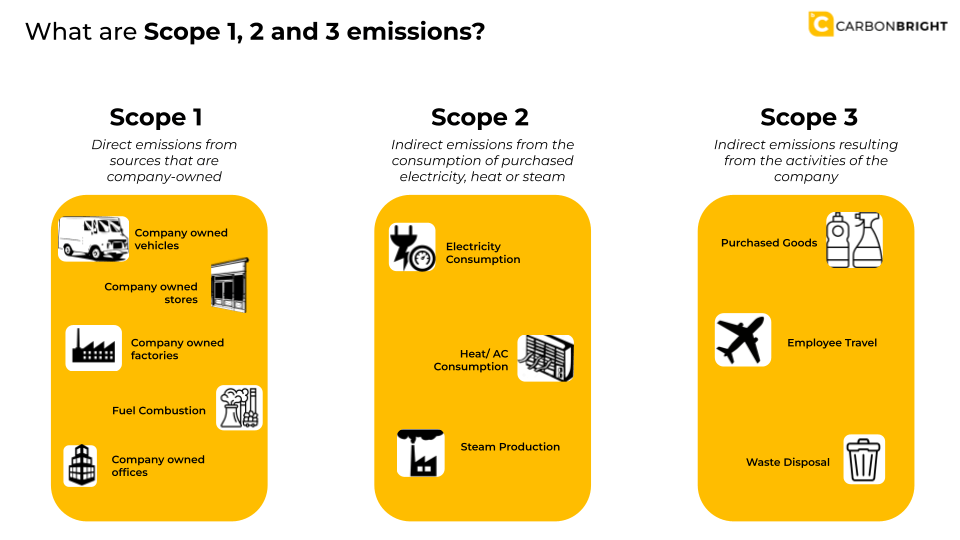
Think of a company’s total carbon footprint as a puzzle made up of three distinct pieces, each defined by how directly the company controls the source of the emissions.
Scope 1: Direct Emissions
Scope 1 covers greenhouse gas emissions from sources a company owns or directly controls. For a manufacturer or CPG company, common examples include:
- Fuel burned on-site in boilers, furnaces, or manufacturing equipment
- Emissions from a company-owned fleet of delivery trucks or forklifts running on gasoline or diesel
- Fugitive emissions, such as refrigerant leaks from on-site cooling and refrigeration systems
Because these sources are directly controlled by the company, Scope 1 is generally the most straightforward scope to measure and the one where a company has the clearest ability to act unilaterally.
Scope 2: Indirect Emissions From Purchased Energy
Scope 2 covers indirect emissions from the generation of purchased electricity, steam, heating, or cooling that a company consumes. The emissions themselves happen at the power plant, not on the company’s own site, but they’re counted against the company because the company is the one driving that demand. Examples include:
- Electricity purchased to run manufacturing lines and production equipment
- Grid electricity used to power warehouses, offices, and cold storage facilities
- Purchased steam or district heating used in industrial processes
Scope 2 is more manageable than it might first appear: switching to a renewable energy contract, installing on-site solar, or relocating production to a facility on a cleaner grid can all meaningfully reduce it.
Scope 3: All Other Value Chain Emissions
Scope 3 covers everything else — all indirect emissions that occur throughout a company’s value chain, both upstream and downstream, that aren’t captured in Scope 1 or 2. For a CPG company, this typically includes:
- Upstream emissions from producing purchased raw materials and packaging (agriculture, mining, plastics production)
- Emissions from third-party logistics and freight carriers transporting goods
- Downstream emissions from how consumers use and eventually dispose of the product
For most manufacturers and CPG companies, Scope 3 represents the large majority of total emissions, often 80% or more of the full footprint, because it captures the entire upstream supply chain and the product’s full life cycle after it leaves the factory. Because these sources sit outside the company’s direct control, Scope 3 is also the hardest to measure and reduce — it depends on the choices and data of suppliers and customers rather than the reporting company itself. For a deeper look at Scope 3, including how companies collect this data and where the biggest reduction opportunities tend to be, see our dedicated guide.
Why the Distinction Matters for Reporting
Separating emissions into three scopes isn’t just an accounting convention — it’s increasingly a legal and financial requirement. Several major disclosure frameworks now require companies to report emissions scope by scope:
- The EU’s Corporate Sustainability Reporting Directive (CSRD) requires in-scope companies to disclose Scope 1, 2, and (where material) Scope 3 emissions as part of mandatory sustainability reporting.
- The SEC’s climate disclosure rule in the US has pushed public companies toward more rigorous, decision-useful climate risk and emissions reporting, with Scope 1 and 2 as a baseline expectation.
- CDP, the widely used environmental disclosure platform, structures its climate change questionnaire explicitly around Scope 1, 2, and 3, and is used by thousands of companies, investors, and supply chain partners to benchmark performance.
Investors, regulators, and large customers use this scope-by-scope breakdown to assess exposure to climate-related risk, evaluate supply chain resilience, and compare companies on a like-for-like basis. A company that only reports Scope 1 and 2, while ignoring the much larger Scope 3 footprint hiding in its supply chain, presents an incomplete and potentially misleading picture of its actual climate impact.
How an LCA-Based Approach Ties All Three Together
It’s tempting to treat Scope 1, 2, and 3 as three separate reporting exercises, each with its own data collection process and spreadsheet. In practice, that approach creates duplicated effort and inconsistent boundaries between scopes.
A Life Cycle Assessment (LCA), conducted according to ISO 14040/14044 standards, avoids that problem by modeling a product’s entire footprint — cradle to grave — as a single connected system. Because an LCA already accounts for raw material extraction, manufacturing energy use, transportation, product use, and end-of-life disposal, the Scope 1, 2, and 3 emissions associated with a product fall out of the same underlying model rather than requiring separate, disconnected calculations. Using recognized databases such as ecoinvent or GaBi for background data ensures that emission factors are applied consistently across every stage, rather than mixing methodologies between scopes.
This matters in practice: a company using an LCA-based approach can produce a Product Carbon Footprint (PCF) and a corporate-level Scope 1/2/3 inventory from the same consistent set of underlying data, rather than reconciling two different systems after the fact. That consistency is what regulators, auditors, and sustainability-conscious customers are increasingly expecting to see.
Understanding where each scope comes from is the first step. Measuring all three consistently, using a rigorous LCA methodology, is what turns that understanding into a credible, defensible emissions inventory.
CarbonBright can help you understand your Scope 1, 2, and 3 emissions — get in touch for a demo today!