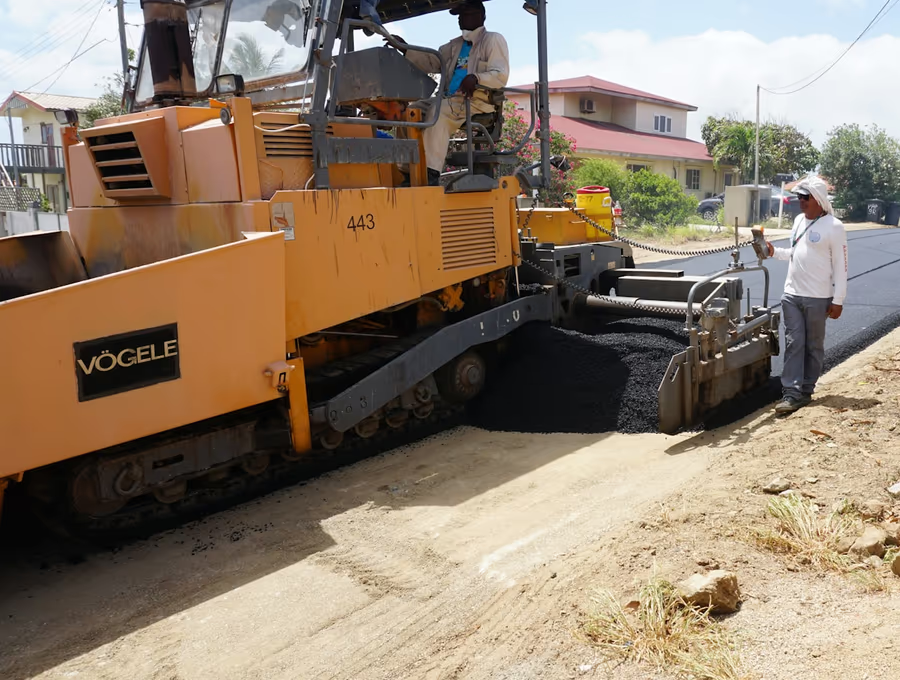
Cement production alone accounts for a significant share of global industrial emissions, which is why concrete and asphalt are named explicitly in nearly every Buy Clean law and infrastructure procurement policy on the books. For ready-mix, precast, cement, and asphalt paving producers, an EPD is no longer a differentiator on a bid — it’s a prerequisite.
What Makes Concrete and Asphalt EPDs Different
Unlike a finished assembly, a concrete or asphalt product’s footprint is driven almost entirely by its recipe: cement content and clinker ratio, binder type, aggregate source, and the share of supplementary cementitious materials (SCMs) like fly ash or slag. EPDs for these products follow EN 15804 and ISO 14025, applied through Product Category Rules written specifically for cementitious and bituminous materials — see our general guide to construction EPDs if you’re new to the standards landscape.
Key Materials Typically Covered in an Asphalt or Concrete EPD
The recipe is the EPD for these products. What gets measured typically includes:
- Cement and clinker — the dominant impact driver in nearly every concrete mix
- Supplementary cementitious materials (SCMs) — fly ash, slag, and other cement replacements, reported as a direct emissions offset
- Aggregates — virgin vs. recycled concrete aggregate (RCA), including sourcing distance
- Asphalt binder (bitumen) — the primary impact driver in paving mixtures
- Reclaimed asphalt pavement (RAP) — quantified as a documented recycled-content benefit
- Admixtures — chemical additives used in smaller quantities but sometimes disproportionate impact
Key Standards and PCRs for Asphalt and Concrete EPDs
Concrete and asphalt are two of the few construction categories with their own dedicated, industry-maintained PCRs rather than a generic construction-products rule:
- NSF 1112 — PCR for Concrete, currently in its third version, published by NSF International and maintained in coordination with the concrete industry’s own trade association
- PCR for Asphalt Mixtures, currently version 2.1, maintained by the asphalt paving industry’s trade association and reviewed against the EPA’s Construction Materials Opportunities to Reduce Emissions (C-MORE) baseline criteria
Both PCRs sit on the same ISO 14025 and EN 15804/ISO 21930 foundation as general construction EPDs, but define mix-specific rules — like how to handle regional aggregate variation and SCM substitution — that a generic construction PCR doesn’t cover.
Top EPD Program Operators for Asphalt and Concrete
Unlike most construction categories, concrete and asphalt each have a sector-specific Program Operator run by their own industry association, in addition to the general operators:
- NRMCA (National Ready Mixed Concrete Association) — the Program Operator for the concrete PCR, verifying and publishing EPDs for ready-mix concrete and concrete ingredients specifically
- NAPA (National Asphalt Pavement Association) — the Program Operator for the asphalt mixtures PCR, publishing verified EPDs through its Emerald Eco-Label program
- UL Solutions and NSF International — general operators, relevant for related products like admixtures or aggregates that fall outside the sector-specific PCRs
Producers of both concrete and asphalt (common for aggregate companies) typically end up working with two separate operators rather than one.
Sample EPDs for Asphalt and Concrete Products
EPD Global’s registry publishes thousands of verified declarations across this category, including:
- Concrete products — precast elements, structural components, and other manufactured concrete products
- Ready-mix concrete — batch-plant declarations by mix design and strength class
- Asphalt and gravel — paving mixtures and aggregate products
Reviewing a handful of published examples in your specific mix category is a practical way to see how competitors report SCM content, recycled aggregate share, and regional plant data.
Why the Sector Can’t Skip EPDs Anymore
Buy Clean procurement now names these materials directly
Concrete and asphalt sit at the top of nearly every Buy Clean policy’s material list, and state transportation departments increasingly require verified EPDs as a bid condition for roads, bridges, and public infrastructure — not just an optional sustainability add-on.
Infrastructure certifications run on verified mix data
Envision and Greenroads, the two leading infrastructure sustainability rating systems, both award credits for materials with published, verified EPDs. That’s a distinct certification track from the LEED/BREEAM building-focused credits that apply to other construction products.
Recycled content is a documented advantage, not just a claim
RAP, RCA, and SCM usage all show up as quantified benefits in an EPD rather than a general “contains recycled materials” statement. For producers already investing in these inputs, an EPD is how that investment gets recognized in a bid evaluation.
Managing EPDs Across Regional Plants and Mix Designs
A single producer might run dozens of mix designs across multiple regional plants, each drawing on different local aggregate and cement sources. Modeling that manually, plant by plant, doesn’t scale. AI-powered EPD software can model mix-design variation directly and generate reports fast enough to meet bid deadlines rather than missing them while a consultant-led study is still in progress.
How to Get Started on Your Asphalt or Concrete EPD
- Decide your product-grouping strategy. Map out which mix designs or paving grades are similar enough to cover under one declaration, and which need to stand alone.
- Gather plant-level data. Cement or binder content, aggregate source and distance, SCM or RAP percentage, energy use, and transport data — ideally per plant if you operate regionally.
- Model against the sector PCR. NSF 1112 for concrete, or the PCR for Asphalt Mixtures for paving products.
- Submit to the relevant sector operator. NRMCA for concrete, NAPA for asphalt — both run verification processes built specifically around mix-design data.
- Publish and keep it current. Update your EPD whenever a mix design, SCM ratio, or plant sourcing changes materially, not just at the five-year renewal mark.
Optimize Your Asphalt and Concrete Sustainability with CarbonBright
CarbonBright’s EPD platform is built to handle regional plant variation and mix-design complexity at scale. Generate verified EPDs fast enough to hit bid deadlines and turn recycled-content investments into a documented procurement advantage. Contact CarbonBright today.