
According to standards in the ISO 14040 and 14044, an LCA is carried out in four distinct phases. These phases are:
- Goal and Scope
- Life Cycle Inventory
- Life Cycle Impact Assessment
- Interpretation
The phases are interdependent. This means none of the stages can be complete until the entire study is complete.
Stage 1a: Goal
At the heart of every LCA lies a clear and concise goal statement. This statement serves as the guiding light. It highlights the purpose of the assessment and outlines how the results will be used.
- What is the Goal in an LCA Study?
- The Goal of an LCA study is an explicit statement, which sets out the context of the study and explains how and to whom the results are to be communicated.
According to ISO standards, a robust goal statement must address several key components:
1. Intended Application:
Clearly define the intended use of the LCA results. For example, internal decision-making, public disclosure, or regulatory compliance.
2. Reasons for Conducting the Study:
Articulate the motivations behind undertaking the assessment,. For example, identify environmental hotspots; compare alternative products; or drive improvements.
3. Target Audience:
Specify the audience for whom the results are intended. I.e. internal stakeholders, consumers, investors, or regulatory bodies.
4. Public Release of Results:
Determine whether the results will be disclosed publicly. Determine if they will be used to make comparative assertions.
Collaborating closely with the team carrying out your study is essential. This will ensure they gain a comprehensive understanding of why the assessment is being conducted.
Stage 1b: Scope
Once the goal is established, the next step is to define the scope of the study.
- What is the Scope in an LCA Study?
- The Scope of an LCA Study describes the detail and depth of the study. It is used to demonstrate that the goal can be achieved within the stated limitations. Unlike the goal statement, which is succinct, the scope often requires more detailed elaboration.
According to ISO guidelines, the scope should encompass the following elements:
1. Product System:
Define the boundaries of the system under study. This should comprise all relevant processes necessary to perform a specific function. This includes activities from raw material extraction to end-of-life disposal or recycling.
2. Functional Unit:
Specify precisely what is being assessed and quantify the service delivered by the system. The functional unit serves as a reference for comparing alternative products or processes. It must be clearly defined to ensure comparability.
3. Reference Flow:
Determine the amount of product or energy required to fulfil the functional unit. This provides a basis for normalisation and comparison across different systems.
4. System Boundary:
Determine the limits or boundaries to be included in the analysis. Consider factors such as co-products, system expansion, and allocation methods. The system boundary should align with the goal of the study.
5. Assumptions and Limitations:
Document assumptions or decisions made throughout the study that may influence the results. Include data quality requirements and sources, to facilitate reproducibility and reliability.
6. Allocation Procedures:
Address the issue of multi-functionality by specifying the method used to partition inputs and outputs, ensuring consistency and comparability in the allocation of environmental burdens.
7. Impact Assessment:
Provide an overview of the impact categories of interest and the methodology used. This lays the groundwork for the subsequent impact assessment phase.
In essence, the goal and scope of an LCA serve as the foundation upon which the entire assessment is built. It ensures stakeholders can ensure the integrity of the LCA results.
Stage 2: Life Cycle Inventory (LCI)
-
What is Life Cycle Inventory (LCI) Analysis?
-
A Life Cycle Inventory Analysis is a detailed inventory of all flows throughout the life cycle of a product or process. This includes raw materials, energy usage, emissions, and waste from creation to disposal.
LCI analysis starts with creating a flow model of the technical system involved in producing the product. This model is often depicted as a flow diagram, illustrating the activities within the system boundary. The more detailed the diagram, the more accurate the results. Data collection is then conducted for all activities within the system boundary.
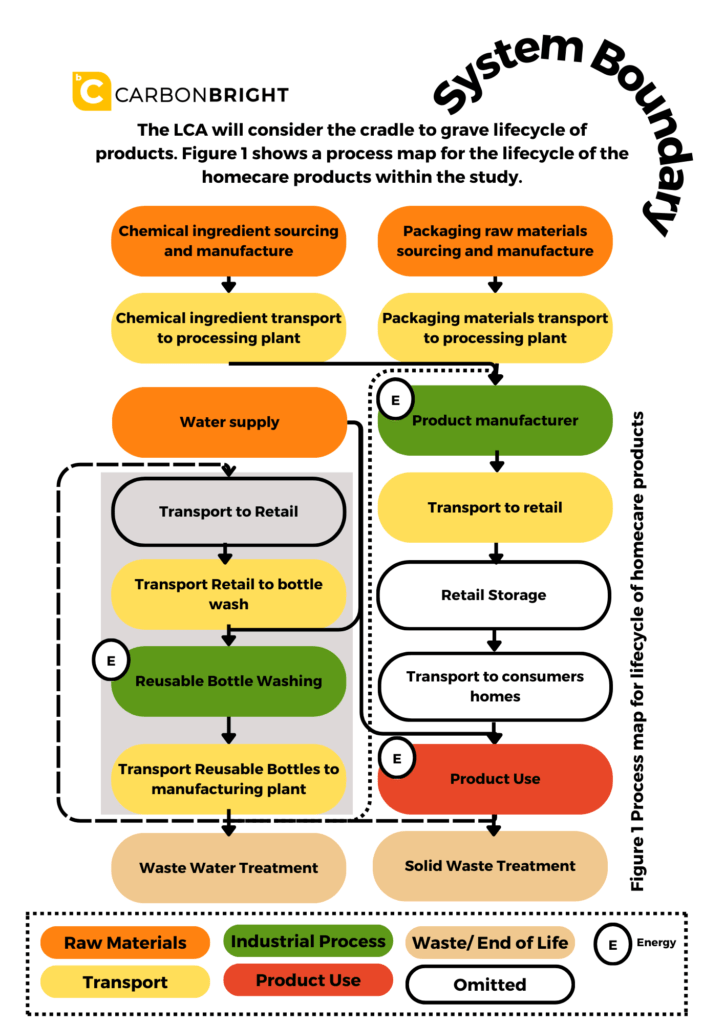
According to ISO standards, the process of LCI analysis involves several key steps:
1. Preparation of Data Collection:
Define the goal and scope of the study to guide data collection efforts.
2. Data Collection:
Gather information on inputs, outputs, and processes within the system boundary.
3. Data Validation:
Ensure the accuracy and reliability of collected data, even if obtained from other sources.
4. Data Allocation:
Allocate flows for processes with multiple inputs or outputs based on predefined procedures.
5. Relating Data to the Functional Unit:
Quantitatively represent each process in relation to the functional unit of the study.
6. Data Aggregation:
Compile all collected data into a structured inventory of elementary flows.
Challenges and Considerations
Collecting data for LCI analysis can be very challenging. Especially when dealing with proprietary or confidential information. In such cases, secondary data sources may be used, such as LCA databases or literature sources. However, it’s crucial to document any discrepancies or limitations associated with secondary data. This will ensure transparency and reliability.
Quality Assurance and Evaluation
The quality of LCI data is evaluated using various methods, including pedigree matrices, which assess data reliability and accuracy based on predefined criteria. These evaluations help ensure the credibility and robustness of LCI results.
Stage 3: Life Cycle Impact Assessment
- What is a Life Cycle Impact Assessment?
- A Life Cycle Impact Assessment evaluates the potential environmental and human health impacts.
Let’s break down the key steps involved in LCIA, as outlined by the ISO 14040 and 14044 standards:
- Selection of Impact Categories:
LCIA begins by selecting relevant impact categories. These categories should be tailored to the justifiable geographical region of the study. Often, practitioners choose existing LCIA methods to facilitate this step. - Classification of Inventory Results:
Next, the results from the LCI are classified into the chosen impact categories. This is based on their known environmental effects. This step is typically facilitated by LCI databases or specialized software. - Characterization:
In this step, the LCI results within each impact category are quantitatively transformed. This is done using characterisation factors to create impact category indicators. This process allows for comparison by converting all classified flows into common units. For instance, Global Warming Potential is commonly expressed in CO2-equivalents.
Optional Steps:
1. Normalization of Results:
Express LCIA results relative to a chosen reference system. i.e. impacts per geographical zone, per person or per industrial sector
2. Grouping of Results:
LCIA results can be grouped or ranked based on defined criteria within the study’s goal and scope. However, grouping is subjective and may vary across studies.
3. Weighting of Impact Categories:
This step determines the relative significance of each impact category. It allows for aggregation of impact scores into a single indicator for comparison. ISO 14044 advises against weighting in studies intended for public disclosure. If weighting is used, both weighted and non-weighted results should be reported.
Stage 4: LCA Interpretation
- What is the Interpretation in a Life Cycle Assessment?
- Life cycle interpretation is a systematic technique to identify, quantify, check, and evaluate information from the results of the life cycle inventory and/or the life cycle impact assessment.
The results are summarized during the interpretation phase. The outcome of the interpretation phase is a set of conclusions and recommendations for the study. According to ISO 14043 the interpretation should include the following:
- Identification of significant issues based on the results of the LCI and LCIA phases of an LCA
- Evaluation of the study considering completeness, sensitivity and consistency checks
- Conclusions, limitations and recommendations
A key purpose of performing life cycle interpretation is to determine the level of confidence in the final results. This ensures all data is communicated in a fair, complete, and accurate manner. This is done by identifying the data elements that contribute the most to each impact category.
- Evaluating the sensitivity of these significant data elements
- Assessing the completeness and consistency of the study
- Drawing conclusions and recommendations
All based on a clear understanding of how the LCA was conducted and the results were developed.
CarbonBright helps companies turn their environmental data into business opportunities. Our LCA software produces fast and scalable life cycle assessments empowering product companies to measure, analyze and lower their product impact. Book a demo today.